
How Founders Can Use the Kano Model to Build Something Customers Love

- July 31, 2026
- Start & Scale E-Learning Series
How Founders Can Use the Kano Model to Build Something Customers Love
Founders often begin with a straightforward question:
What features should we build?
It is an important question, though it is not always the best place to begin.
Customers do not value every feature equally. Some features are expected. Some directly increase satisfaction when they perform well. Others can create genuine delight because the customer did not anticipate them.
This is the central idea behind the Kano Model.
The framework helps founders see what needs fixing, what can be improved, and where there may be an opportunity to create something memorable.
KANO Framework Challenge
The Research and Book Behind the Framework
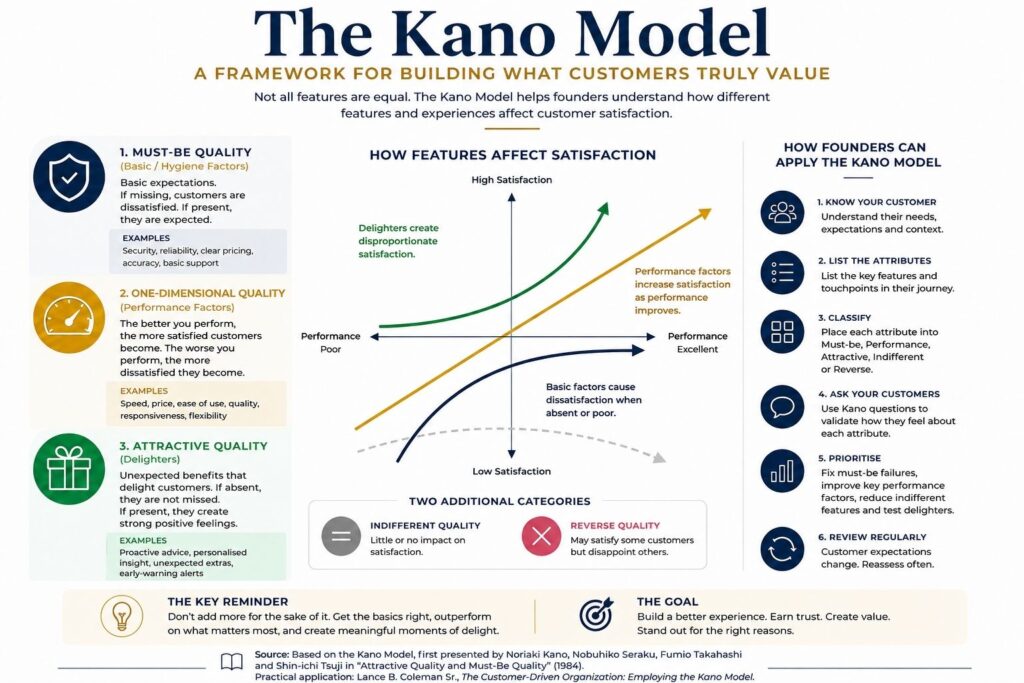
The Kano Model originated in the 1984 paper Attractive Quality and Must-Be Quality, written by Professor Noriaki Kano and his colleagues Nobuhiko Seraku, Fumio Takahashi, and Shin-ichi Tsuji.
KANO Framework
Their work challenged the idea that every improvement produces the same increase in customer satisfaction. Instead, it proposed that different product and service attributes affect satisfaction in different ways.
A useful modern guide to applying the model is Lance B. Coleman Sr.’s book:
The Customer-Driven Organisation: Employing the Kano Model
Coleman did not create the Kano Model. His book explores how organisations can apply Kano principles to identify customer needs, set priorities, improve efficiency, and build stronger customer relationships.
For founders, the value of the framework is simple:
It helps you focus your time and resources on what matters most to customers, while protecting the essentials and finding opportunities to stand out.
A Great Product Is Not Just a Collection of Features
Many founders judge their product by how much it can do.
They may focus on:
- New functionality
- Additional services
- More automation
- More customisation
- Better technology
- More options
- New integrations
Customers may evaluate the experience differently.
They are often asking:
- Does the basic product work reliably?
- Does it solve the problem better than my current option?
- Is it easy to use?
- Will it save me time?
- Can I trust the company?
- Is there anything here that makes the experience noticeably better?
Adding more is not always what makes the difference.
A founder may invest heavily in an exciting new feature while customers are still frustrated by unclear pricing, slow responses, or a difficult onboarding process.
The Kano Model offers a practical way to decide where improvement will have the greatest impact.
The Main Kano Categories
The original theory distinguishes between several categories of quality. The three most useful categories for a founder beginning to apply the framework are:
- Must-be quality
- One-dimensional quality
- Attractive quality
In everyday business language, these are often described as:
- Basic or hygiene factors
- Performance factors
- Delighters
“Hygiene factor” is not the original Kano term. The correct formal term is must-be quality. However, the informal phrase can help teams understand that these are the basic requirements that must be delivered consistently.
1. Must-Be Quality: Get the Basics Right
Must-be qualities are the basic features or standards customers expect.
When they are delivered properly, customers may barely notice them. When they are absent or poorly delivered, dissatisfaction can rise quickly.
For an online retailer, must-be qualities might include:
- Secure payment
- Accurate product descriptions
- Transparent delivery information
- Correct orders
- A clear returns process
For a consultant, they might include:
- Turning up prepared
- Communicating clearly
- Meeting deadlines
- Protecting confidential information
- Delivering what was agreed
For a software company, they could include:
- Reliability
- Security
- Access to core functions
- Data protection
- Basic customer support
These factors rarely make a business stand out.
They make the business credible and trustworthy.
No impressive extra feature can make up for unreliable service.
Ask yourself:
What does our customer assume will happen, and where might we currently be falling below that expectation?
2. One-Dimensional Quality: Improve What Customers Compare
One-dimensional qualities are often referred to as performance factors.
In general, customer satisfaction rises with performance and falls with declines in performance.
These are the areas customers are more likely to compare directly between providers.
They may include:
- Speed
- Price
- Product quality
- Accuracy
- Ease of use
- Responsiveness
- Flexibility
- Capacity
- Results
- Level of support
For example, if customers care about delivery time, faster delivery may increase satisfaction.
If customers care about reporting, clearer and more useful reports may increase satisfaction.
If customers value personal support, faster, more relevant responses may strengthen the experience.
The challenge for founders is that they cannot usually lead on every performance measure.
Trying to be the cheapest, fastest, most personalised and most comprehensive provider at the same time can weaken the offer.
It is more valuable to identify the few performance factors that matter most to your ideal customer.
Ask:
Which aspects of our offer do customers actively compare, and where could we become noticeably better?
3. Attractive Quality: Create Genuine Delight
Attractive qualities are often called delighters.
These are features or experiences that customers may not have expected. Their absence may not cause dissatisfaction, but their presence can create a strong positive response.
Examples might include:
- A consultant providing a useful action plan after an initial conversation
- A software platform identifying a problem before the customer notices it
- A service provider making a valuable introduction without being asked
- A retailer including genuinely useful guidance with a purchase
- A programme continuing to support participants after the formal end date.
- A business remembering and acting on a customer’s preferences
The strongest delighters are not random extras.
They usually do one of four things:
- Remove anxiety
- Save time
- Create confidence
- Make the customer feel understood.
This is often where a smaller business can compete most effectively.
A start-up may not have the budget or scale of a larger competitor, but it can often offer a more thoughtful, personal, or responsive experience.
Ask:
What could we offer that customers would genuinely value but wouldn’t normally expect from a business like ours?
Two Additional Kano Categories
The wider Kano Model also includes indifferent and reverse qualities.
Indifferent quality
An indifferent feature has little meaningful effect on customer satisfaction.
The company may invest time and money in it, but customers may not care enough for it to influence their decision.
For example, a founder may be proud of a highly technical feature that customers rarely use or understand.
Reverse quality
A reverse quality may appeal to some customers but reduce satisfaction for others.
For example:
- Extensive automation may appeal to customers who value speed but frustrate those who want human support.
- A highly detailed interface may appeal to expert users but overwhelm beginners.
- Frequent notifications may feel helpful to one customer and intrusive to another.
This is an important reminder that Kano categories are not permanently attached to a feature.
The category can vary according to the customer group, product, context, and market.
The Same Feature Can Mean Different Things to Different Customers
A feature should not be labelled a delighter, basic requirement, or performance factor based only on internal opinion.
The same feature may fall into different categories depending on the customer.
For example:
A highly experienced software user may expect advanced reporting as a basic feature.
A first-time user may see the same reporting as overwhelming and place greater value on simple guidance.
A corporate customer may view data security as a basic requirement.
A small consumer customer may give it less conscious attention, even though it remains operationally essential.
Founders therefore need to identify:
- Who is the customer
- What they already expect
- What alternatives are they comparing
- Which problems matter most to them
- How experienced they are
- What they are willing to pay for
The Kano Model is most useful when applied to a clearly defined customer segment.
Why Founders Often Get the Order Wrong
Many early-stage businesses begin by creating delighters.
They develop:
- Sophisticated features
- Elaborate packaging
- Extra service options
- Complex personalisation
- Advanced technology
- Unexpected gifts
- Large feature lists
These additions may look impressive, but they cannot repair a weak foundation.
A polished app cannot compensate for unreliable core functionality.
A welcome gift cannot compensate for poor communication.
A beautifully designed website cannot compensate for confusing pricing.
A friendly community cannot replace a clear onboarding process.
The practical sequence is:
Protect the must-be qualities, improve the most important performance factors, and then test carefully chosen delighters.
A Founder-Focused Example
Imagine a founder has created a project-management platform for small construction companies.
The platform includes:
- Task management
- Project timelines
- Document storage
- Automated reminders
- Progress reports
- Team dashboards
The founder may believe the automated reporting feature is the most exciting part of the product.
Customers may experience it differently.
Must-Be Qualities
Customers may expect:
- Secure access
- Reliable document storage
- Correct project information
- User permissions
- Mobile access
- Basic support
- Clear pricing
If these are weak, the product may lose trust regardless of its advanced features.
Performance Qualities
Customer satisfaction may rise when the platform delivers:
- Faster setup
- Easier navigation
- Better reporting
- Quicker response times
- More useful reminders
- Better integration with existing tools
- Reduced administrative work
The founder should identify which of these factors matters most to the target customer.
Attractive Qualities
Potential delighters might include:
- Identifying a likely project delay before it occurs
- Automatically preparing a simple client update.
- Providing a personalised implementation plan
- Importing the customer’s existing project information
- Offering a useful industry template
- Connecting the business with a relevant expert
There is no need to build all of these.
The aim is to test which unexpected benefit creates real value for your customers.
The Kano Model Is Not a Reason to Add More Features
It is easy to misunderstand customer delight as a reason to build additional features.
That is not the purpose of the framework.
A delighter should not be added simply because it is unusual.
It should contribute meaningfully to the customer experience.
Before investing in a potential delighter, ask:
- Does it solve a real problem?
- Will the customer understand its value?
- Does it support our positioning?
- Is it affordable to deliver?
- Can we provide it consistently?
- Does it distract from the core product?
- Is it valuable to our ideal customer, or only interesting to us?
A simple experience that works well is often more compelling than a complicated one filled with extras.
How Founders Can Apply the Kano Model
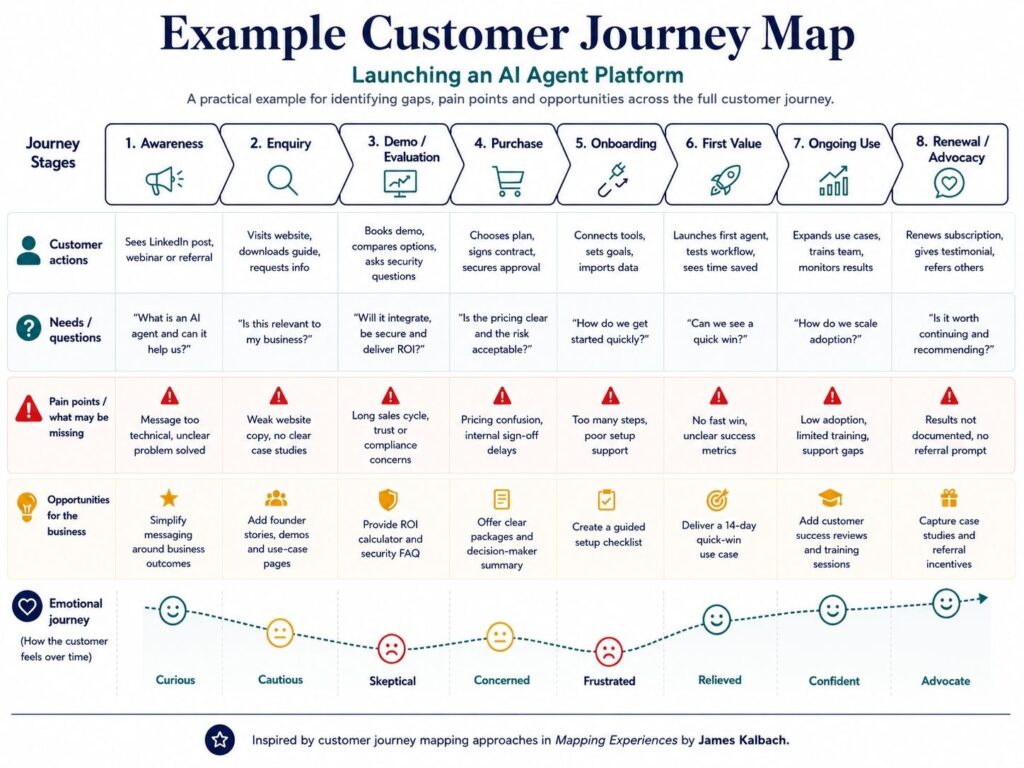
Step 1: Map the Customer Journey
Customer Journey Map AI Company
Review every stage the customer experiences.
Customer satisfaction is shaped by the whole journey, not just the product itself.
Step 2: List the Experience Attributes
Write down the main features and service elements involved.
These could include:
- Product quality
- Price
- Communication
- Response time
- Delivery
- Onboarding
- Support
- Reporting
- Personalisation
- Convenience
- Expertise
- Training
- Follow-up
- Community
- Technology
Step 3: Create an Initial Classification
Place each attribute into one of five columns:
| What customers expect | What customers compare | What could create delight | What may not matter | What some customers may dislike |
This first version is simply a starting point.
It is not a substitute for real customer insight.
Step 4: Speak to Customers
Ask customers about both the presence and absence of a feature.
Traditional Kano questionnaires commonly use paired questions:
- How would you feel if this feature were provided?
- How would you feel if this feature were not provided?
The response combination can then be used to help classify the attribute.
A simpler founder interview might ask:
- What did you expect before buying?
- What would have caused you to reject the offer?
- Which parts influenced your decision?
- What frustrated you?
- What made the experience easier?
- What surprised you positively?
- What would you miss most if it disappeared?
- Which features do you rarely use?
- Is there anything we provide that actually makes the experience more difficult?
Step 5: Compare Different Customer Groups
Do not combine every customer into one group.
A feature may be classified differently by:
- New and experienced users
- Small and large customers
- Consumer and business customers
- High-value and low-value segments
- Domestic and international clients
- Technical and non-technical users
The Kano Model becomes more useful when the founder can see how expectations vary between segments.
Step 6: Prioritise Investment
A practical order is:
- Correct must-be failures that damage trust.
- Improve the performance factors customers value most.
- Remove or reduce investment in indifferent features.
- Review reverse features for different customer segments.
- Test one or two credible delighters.
- Measure the effect on behaviour and satisfaction.
Possible measures could include:
- Customer retention
- Conversion rate
- Onboarding completion
- Usage
- Support requests
- Referrals
- Repeat purchases
- Customer satisfaction
- Qualitative customer feedback
Customer Expectations Can Change
A feature may begin as an attractive quality and later become expected.
This happens as:
- Competitors copy it
- Technology becomes more common.
- Customers become more experienced.
- Industry standards rise
- New habits develop
A feature that once felt remarkable may eventually become a must-be requirement.
This means a Kano analysis is not something to complete once and leave unchanged.
It is worth reviewing customer expectations regularly, especially when:
- Entering a new market
- Launching a new product
- Serving a new customer segment
- Facing new competitors
- Changing the price
- Redesigning the customer journey
Research reviewing the development of attractive quality theory has also examined how quality attributes may change over time rather than remaining fixed permanently.
Using the Kano Model in Marketing
The framework can also help founders communicate their offer more clearly.
Must-Be Qualities Reassure
These messages reduce risk:
- Secure
- Reliable
- Compliant
- Transparent
- Easy to access
- Professionally supported
These qualities matter, but they may not be enough to set your business apart.
Performance Qualities Demonstrate Value
These messages explain why the offer performs better:
- Faster
- Simpler
- More accurate
- More flexible
- Better supported
- More cost-effective
- Easier to implement
These factors often form the basis of comparison for your customers.
Attractive Qualities Create Differentiation
These messages explain what the customer receives that they may not expect:
- Proactive advice
- Personalised insight
- Implementation support
- Valuable introductions
- Early-warning information
- Continued follow-up
- Unexpected access to expertise
A strong marketing message may combine all three:
A reliable foundation, a clear performance advantage, and one meaningful reason for customers to remember your business.The Kano Model and Product-Market Fit
The Kano Model does not prove that a company has product-market fit.
However, it can help founders investigate why customers respond positively or negatively to an offer.
If customers are not buying, the issue may be that:
- A basic requirement is missing.
- A performance factor is weaker than competing options.
- The company is investing in features customers consider indifferent.
- The offer contains complexity that some customers dislike
- The supposed delighter does not solve a meaningful problem.
- The business is targeting the wrong customer segment.
For example, a founder may assume that customers want more functionality.
Customer interviews may reveal that they actually want:
- Simpler onboarding
- More confidence
- Less risk
- Faster support
- Clearer pricing
- Better integration
The solution may not be to add more.
It may be to improve what matters most.
Do Not Confuse Delight With Gimmicks
A delighter should strengthen the customer’s experience.
It should not be included only to attract attention.
A useful delighter might:
- Prevent a problem
- Reduce effort
- Create an early result.
- Make the customer feel supported.
- Provide insight
- Offer relevant access
- Remove uncertainty
A gimmick may be surprising, but it rarely creates lasting value.
Founders should ask:
Would the customer still value this once the novelty wears off?
Five Questions Every Founder Should Ask
Review your current product, service or programme and ask:
1. What must work perfectly?
Which failures would immediately damage trust?
2. What do customers actively compare?
Where does better performance clearly increase value?
3. What could genuinely delight them?
What useful benefit would they value but may not expect?
4. What are we investing in that customers barely notice?
Which features may be indifferent?
5. Could any part of the experience frustrate a customer segment?
Which features might produce a reverse response?
These questions can be used when:
- Designing a new product
- Reviewing a service
- Developing a programme
- Prioritising a roadmap
- Improving onboarding
- Updating a website
- Refining a sales proposition
The Growth Lesson for Founders
Customers do not experience every feature equally.
Some things protect trust.
Some improve satisfaction.
Some create a memorable difference.
Others may add complexity without adding meaningful value.
The Kano Model encourages founders to stop asking:
How can we add more?
And begin asking:
What must we get right, where should we perform better, and what could we do that customers would truly value?
When founders answer those questions using real customer insight, they can make better decisions about:
- Product development
- Customer experience
- Marketing
- Pricing
- Investment
- Team priorities
- Growth
Your Challenge:
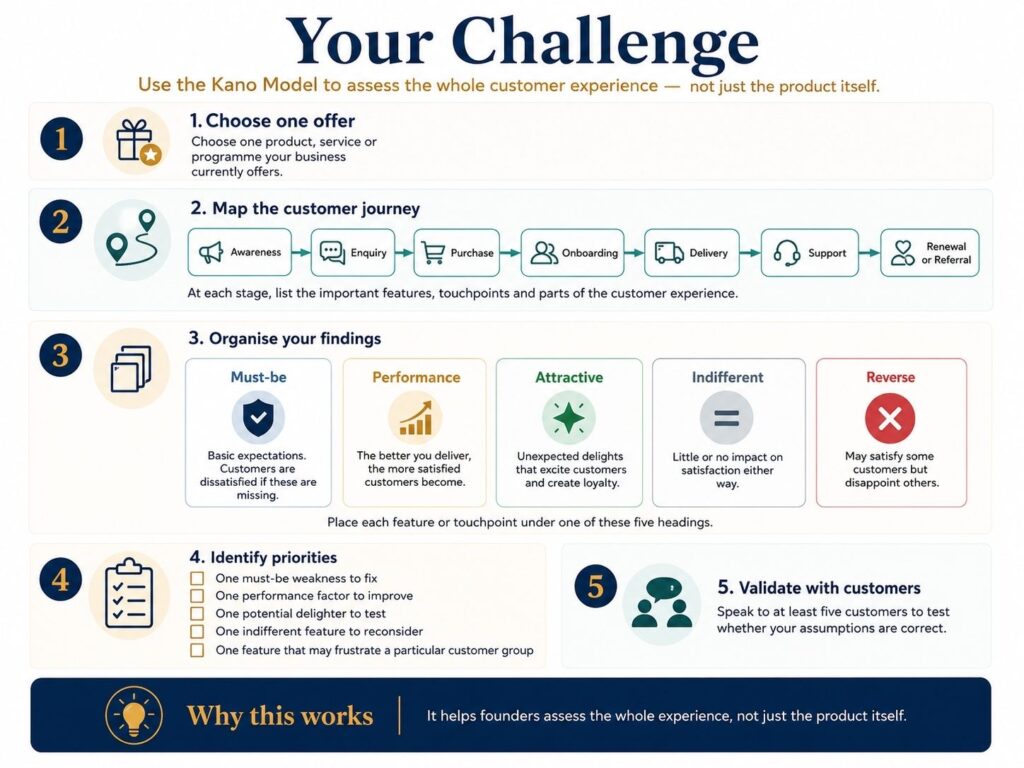
Choose one product, service, or programme your business currently offers.
First, map the main stages of the customer journey, for example:
Awareness → Enquiry → Purchase → Onboarding → Delivery → Support → Renewal or Referral
At each stage, list the important features, touchpoints, and parts of the customer experience.
Then organise them under five headings:
- Must-be
- Performance
- Attractive
- Indifferent
- Reverse
Now identify:
- One must-be weakness to fix
- One performance factor to improve
- One potential delighter to test
- One indifferent feature to reconsider
- One feature that may frustrate a particular customer group
Finally, speak to at least five customers to test whether your assumptions are correct.
This version is better because it helps founders assess the whole experience, not just the product itself.
Finally, speak to at least five customers before treating your classifications as accurate.
You may discover that the feature your team is most excited about is not the feature customers value most.
You may also discover that the strongest opportunity is not another new feature.
It may be a better, simpler, and more thoughtful experience for your customers.
Because customers are not only asking:
What does this product do?
They are also asking:
Can I trust it? Will it perform well? And is there a reason I would choose it over everything else?
Developed by Blueberry Design