
Funding the Future: A Founder’s Guide to Investment in Ireland

- August 5, 2026
- Start & Scale E-Learning Series
Funding the Future: A Founder’s Guide to Investment in Ireland
Every ambitious start-up, at some point, faces a familiar question.
How do we secure the investment needed to turn this opportunity into a scalable business?
You may have built a strong product, found your first customers, and identified a real market need. Yet without the right capital, it can be difficult to build your team, develop your technology, or pursue new opportunities at the pace you need.
Investment can accelerate growth, but raising money is not the end goal.
The real goal is to build a valuable, sustainable business. Investment is just one of the tools that can help you get there.
The funding journey rarely begins with an investor
Imagine an Irish founder with an exciting product and ambitions to enter the UK, Europe, and the US.
They prepare a pitch deck, calculate how much money they need, and begin contacting investors. After weeks of conversations, the responses are disappointing:
- “It’s too early for us.”
- “Come back when you have more traction.”
- “We need stronger evidence of product–market fit.”
- “This opportunity doesn’t fit our investment model.”
It is easy to conclude that Ireland lacks enough investors. While access to capital is part of the challenge, it is rarely the whole story.
Sometimes, the business is reaching out to the wrong type of investor, at the wrong stage, or without enough evidence that new capital will drive meaningful growth.
Before asking, “Who will invest in us?”, founders should ask:
What evidence must we create to make this business a credible and attractive investment opportunity?
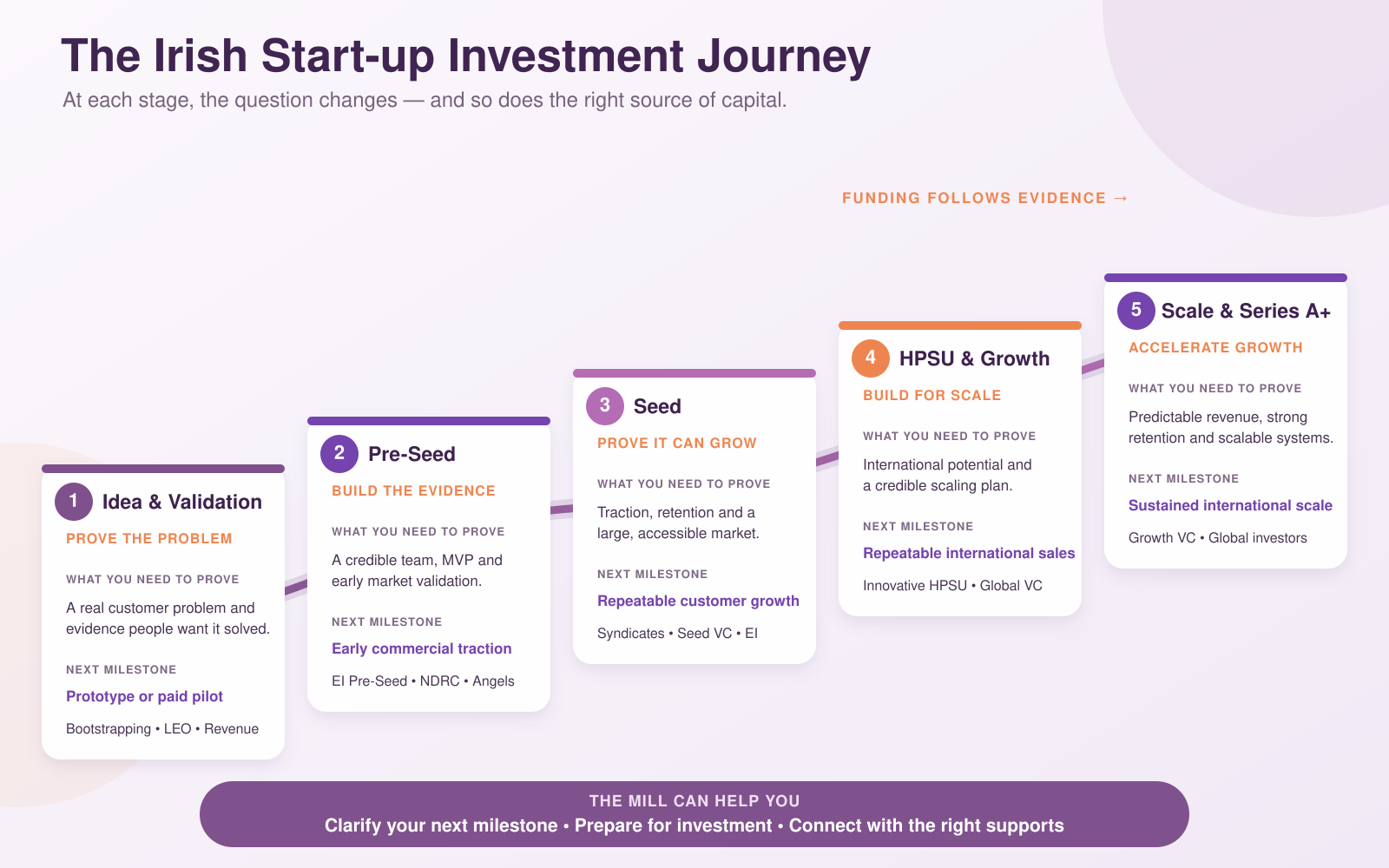
Asking this question can reshape the entire fundraising journey.
What is happening in the Irish investment market?
Ireland has developed a strong start-up ecosystem supported by Enterprise Ireland, the Local Enterprise Offices, NDRC, accelerators, angel investors, private investment networks, and venture-capital firms.
Irish technology SMEs raised a record €1.48 billion in venture capital investment in 2024. However, the opening quarter of 2026 was considerably weaker, particularly for early-stage and smaller investment rounds.
In the first quarter of 2026, Irish technology SMEs raised €221.7 million, 58% less than during the corresponding period in 2025. Investment in deals valued below €10 million reportedly fell by 77%. This decline may have significant implications for early-stage Irish companies seeking smaller funding rounds.
These figures do not suggest a permanent decline in investment. They do highlight that founders cannot assume funding will always be available, even with a promising idea.
Preparation, timing, and investment readiness all matter.
The role of Enterprise Ireland
Enterprise Ireland remains a significant source of early-stage investment.
In 2025, it invested €32.9 million in Irish start-ups and supported 198 companies, including 90 High Potential Start-Ups and 108 businesses supported through early-stage funding.
Click here to view funding supports
This included:
- €23 million in equity investment approved for High Potential Start-Ups
- €9.55 million in Pre-Seed Start Fund investment
- Separately, Seed and Venture Capital Schemes supported by Enterprise Ireland invested €80 million across 76 Irish companies in 2025.
- 55 female-led early-stage companies
- 99 companies with AI at the center of their product or service
Enterprise Ireland
These figures show that funding is available, but not every promising business is ready for equity investment, and venture capital is not always the right route for every founder.
Start with the right type of funding
A common fundraising mistake is to focus on the amount of money wanted, rather than the next milestone the business needs to reach.
The correct funding route depends on:
- The company’s stage of development
- Its business model
- The evidence already created
- Its growth and international potential
- How the funding will be used
- The return an investor could reasonably expect
Idea and validation stage
At this stage, the priority should be reducing uncertainty.
Potential funding routes include:
- Founder savings and bootstrapping
- Early customer revenue
- Paid pilot projects
- Local Enterprise Office supports
- Innovation vouchers and research supports
- Accelerators and pre-accelerators
- Start-Up Relief for Entrepreneurs
- Friends and family, supported by appropriate legal agreements
A Local Enterprise Office Feasibility Study Grant may help qualifying businesses research market demand, develop a prototype, evaluate technical feasibility, and determine whether a proposed business can become viable and sustainable. Availability, amounts, and eligibility can vary, so founders should speak directly to their Local Enterprise Office.
Local Enterprise Office
Click here to view funding supports
At this stage, the goal is not to create the most impressive pitch deck.
It is to show that a real problem exists and that customers care enough to adopt, or ideally pay for, your solution.
Pre-seed stage
A pre-seed company should normally be developing evidence of:
- A clearly defined customer and problem
- A credible founding team
- A minimum viable product or prototype
- Customer discovery and market validation
- An initial route to market
- A realistic plan for using investment
- The potential to reach a substantial market
Enterprise Ireland’s Pre-Seed Start Fund currently provides eligible early-stage companies with an investment of €50,000 or €100,000, together with ten mentoring sessions.
The purpose is to help early-stage companies achieve the technical and commercial milestones required to attract future seed investment. Enterprise Ireland Pre-Seed Start Fund
NDRC also provides founder-focused programmes, mentoring, and investment pathways for technology start-ups with global ambitions. NDRC
Seed stage
At seed stage, the question begins to change from “Could this work?” to “Is there credible evidence that this can grow?”
Investors are likely to examine:
- Market size and international potential
- Commercial traction
- Customer acquisition and retention
- Product–market fit
- The strength of the founding and leadership team
- Competitive differentiation
- Unit economics
- Intellectual property
- Financial projections and cash runway
- The milestones the investment will unlock
- Potential returns and routes to exit
A compelling vision can open the conversation.
Evidence is what keeps it moving forward.
Click here to view funding supports
High Potential Start-Up and scaling stage
For internationally focused businesses with a minimum viable product and strong growth potential, Enterprise Ireland’s Innovative HPSU Fund currently offers qualifying businesses co-funded equity investment of up to €1.2 million.
Eligibility, assessment, and co-funding conditions apply. Enterprise Ireland Innovative HPSU Fund
Companies at this stage may also consider:
- Irish and international venture-capital funds
- Specialist sector funds
- Angel investors and syndicates
- Family offices
- Strategic corporate investors
- Enterprise Ireland-supported seed and venture funds
- International investors with relevant market access
The most valuable investor is not always the one offering the largest cheque.
The right investor should understand the company’s market, stage, ambition, and likely journey.
What is an investor really evaluating?
An investor is not simply buying part of the company as it exists today.
They are assessing the likelihood that it can become substantially more valuable in the future.
They need to believe four things:
1. The outcome is attractive
Does the company solve an important problem in a sufficiently large or rapidly growing market?
Could it become a significant, scalable business?
2. The likelihood of success is credible
Can the team execute its plan?
Is there evidence of customer demand? Are customers buying, returning, expanding their contracts, or recommending the product?
What has already been proven, and what remains an assumption?
3. Progress can happen within a reasonable timeframe
Will the investment create measurable progress before the company needs to raise money again?
Is there a clear route from today’s position to the next significant milestone?
4. The risk and effort are manageable
Is the company legally and financially organised?
Is the cap table clear? Is the intellectual property protected? Are the financial records reliable? Can the investor complete due diligence without discovering avoidable problems?
Applying the value equation to investment
The value equation provides a useful way to understand how investors may evaluate an opportunity:
Value increases when the desired outcome and perceived likelihood of success rise—and when the anticipated delay, risk, effort, and uncertainty fall.
Founders frequently concentrate almost entirely on the dream outcome:
- The size of the market
- The scale of the opportunity
- The international potential
- The projected company valuation
Investors also evaluate:
- How likely is the team to deliver that outcome
- How long it may take
- How much additional capital will be required
- What could prevent the business from succeeding
- How difficult will the investment be to manage or exit
A successful investment proposition must address all four areas.
Tell investors what their money will change
“We want to raise €500,000 to grow the business” is not a complete investment case.
A stronger explanation would be:
“This investment will fund two senior commercial appointments, complete the product’s enterprise-security requirements, and support entry into the UK market. Over the following 18 months, our objective is to move from ten to 40 paying customers, establish a repeatable sales process and position the business for a larger seed round.”
An investor needs to understand:
- Why is this amount required
- Why is it needed now
- Where it will be spent
- What milestones will it achieve
- How long should the funding last
- What measurable value should be created
- What becomes possible once those milestones are reached
Investment should finance progress, not simply postpone a cash crisis.
A practical investment-readiness test
Before approaching investors, a founder should be able to answer the following questions clearly:
1. What important problem are we solving?
2. Who experiences this problem most urgently?
3. What evidence shows that customers want our solution?
4. Why is our solution meaningfully different?
5. How large is the accessible market?
6. How will we acquire customers repeatedly and profitably?
7. Why is this the right team to build the company?
8. How much capital do we need?
9. What exact milestones will that capital achieve?
10. Why could this become an attractive investment?
11. What are the principal risks?
12. What type of investor would add the greatest value?
13. What percentage of the company are we prepared to exchange?
14. What happens if the investment takes longer than expected to secure?
If the answers are unclear, taking time to prepare may create more value than starting a fundraising campaign straight away.
How Ireland currently supports private investors
Ireland already provides tax incentives intended to encourage private investment in qualifying companies.
The Employment Investment Incentive, or EII, allows qualifying individual investors to claim Income Tax relief on qualifying equity investments.
Depending on the company, investment type, and method of investment, the maximum rates of relief are currently:
- 50% for certain initial investments in companies not yet operating in a market
- 35% for certain initial or follow-on investments in qualifying younger companies
- 20% for certain expansion or later follow-on investments
- 30% for qualifying investments made through qualifying investment funds
The actual benefit depends on the investor’s individual tax circumstances, the nature of the company and investment, and compliance with all relevant conditions.
Eligible shares must generally be held for four years. Qualifying investors may claim relief on relevant investments of up to a combined annual limit of €1 million, with unused relief potentially carried forward, subject to the rules. Revenue’s EII investor guidance
Ireland has also introduced Relief for Investment in Innovative Enterprises.
This may allow qualifying investors who are unconnected to an eligible company to benefit from a reduced effective Capital Gains Tax rate of:
- 16% on qualifying direct investments
- 18% on qualifying investments made through a partnership
The relief is subject to detailed company, investment, certification, holding-period, and gain limits. Revenue
These are valuable supports. The challenge is not a lack of incentives for investors in Ireland.
The opportunity is to make these incentives easier to understand, more predictable to use, and visible enough to influence investor behavior.
What can Ireland learn from the UK?
The UK provides a useful comparison because its Enterprise Investment Scheme and Seed Enterprise Investment Scheme are widely recognised among founders, advisers and private investors.
For the UK’s 2025/26 tax year:
- The Seed Enterprise Investment Scheme, or SEIS, offered qualifying investors 50% Income Tax relief on investments of up to £200,000.
- The Enterprise Investment Scheme, or EIS, offered 30% Income Tax relief on qualifying investments.
- Capital Gains Tax reliefs could also apply, depending on the scheme and the investor’s circumstances.
HMRC SEIS guidance and HMRC EIS guidance
The UK Government explicitly positions these schemes as a way to help early-stage companies raise capital by reducing some of the financial risk borne by individual investors.
Ireland should not simply copy another country’s system. However, it can learn from the familiarity, visibility, and relative clarity that have made EIS and SEIS an established part of the UK start-up investment landscape.
Stronger, simpler, and more predictable incentives could encourage more private individuals to consider early-stage investment in Ireland.
Potential improvements could include:
- A simpler and more predictable relief process
- Faster confirmation that companies qualify
- Clearer guidance for first-time angel investors
- Greater promotion of existing incentives
- Increased support for regional angel networks and syndicates
- Incentives that reward patient, early-stage investment
- More opportunities for founders to meet suitable investors
- Support to help successful entrepreneurs become informed angel investors
These measures would not remove the substantial risks associated with start-up investment.
They could, however, reduce unnecessary friction and make it easier for credible founders and informed investors to connect.
At The Mill Enterprise Hub, our role is to help ambitious founders and businesses connect with the people, programmes, expertise and opportunities that support the next stage of their journey.
Because the goal is not simply to raise investment. The goal is to build a business that is truly worth investing in.
Click here to view funding supports
This article was prepared using information available in August 2026. Funding programmes, limits, tax incentives, and eligibility requirements may change. This article provides general information and should not be treated as financial, investment, legal, or tax advice. Founders and investors should seek professional advice tailored to their circumstances.
Developed by Blueberry Design