Why Founders Need to Build an Offer Customers Truly Value

- July 28, 2026
- Start & Scale E-Learning Series
Why Founders Need to Build an Offer Customers Truly Value
Founders often find themselves deeply focused on their product, service, or technology.
You understand how much work has gone into building it. You know the problem it solves, the thinking behind it, and the features that make it different.
Your potential customers, however, see it from a different perspective.
They are asking:
Will this help me achieve the result I want?
This is where value becomes central.
In his book, $100M Offers: How to Make Offers So Good People Feel Stupid Saying No, entrepreneur and investor Alex Hormozi introduces a framework called the Value Equation.
This model helps explain why some offers feel immediately compelling, while others struggle to gain traction, even when the product itself is strong.
A Great Product Is Not Always a Great Offer
Many founders spend months or years developing a product.
They refine the features, improve the technology, and solve technical problems. They know exactly how the product works.
Yet customers are not buying the effort behind the product.
They are choosing the result they believe it can deliver.
A software founder may describe:
- The platform’s features
- Its integrations
- Its dashboard
- Its automation capabilities
- The technology behind it
The customer may want:
- To save time
- To reduce costs
- To increase sales
- To avoid mistakes
- To make better decisions
- To simplify a difficult process
The product matters, but it is the offer that connects what you have built to the outcome your customer is seeking.
A strong offer helps the customer quickly understand:
- What problem you solve
- What result they can expect
- Why your solution is credible
- How quickly they will see progress
- How difficult the process will be
Here, the Value Equation can provide useful guidance.
What Is the Value Equation?
Hormozi describes value through four elements:
Value = (Dream Outcome × Perceived Likelihood of Achievement) ÷ (Time Delay × Effort and Sacrifice)
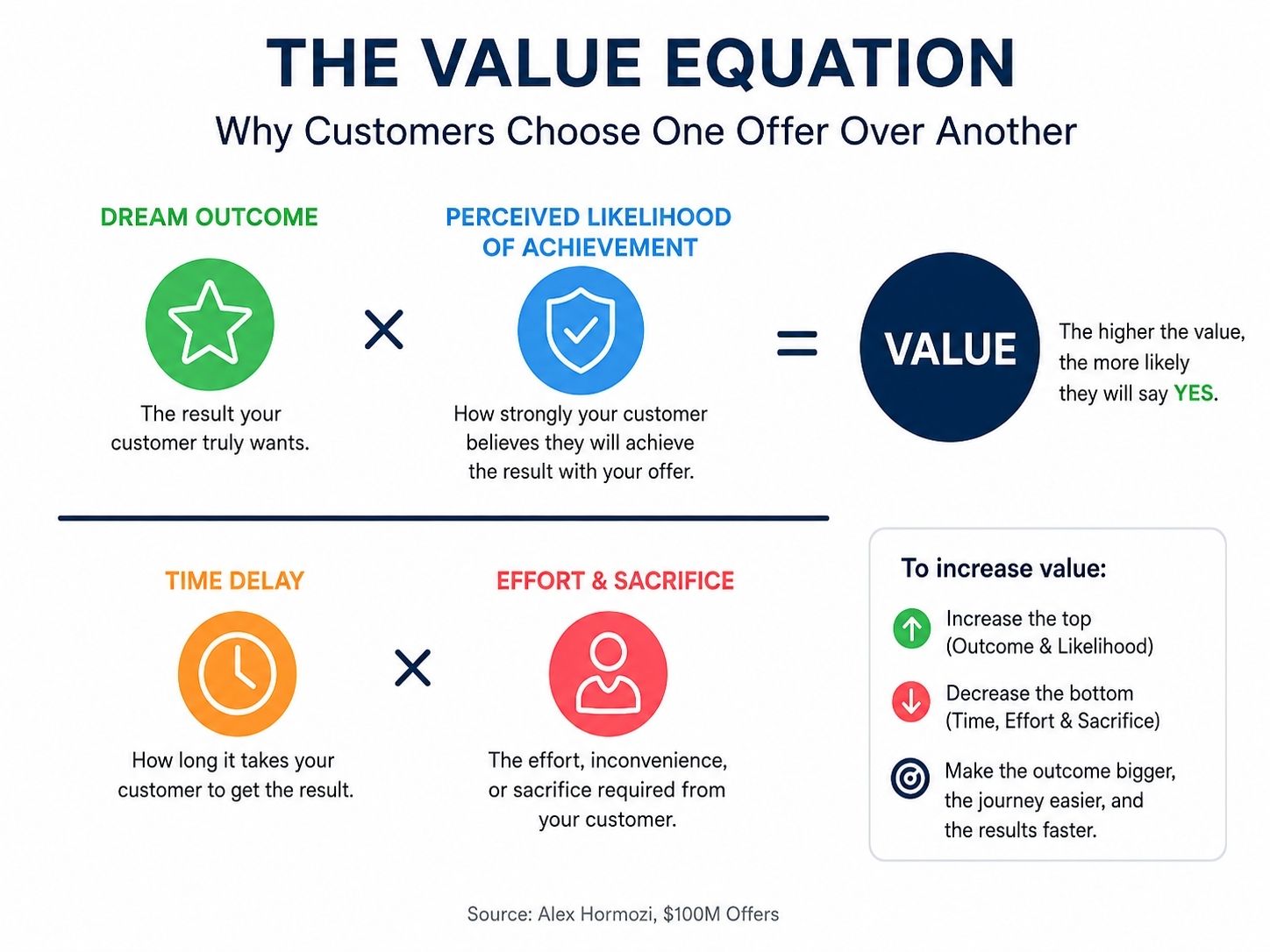
In simple terms, customers see greater value when:
- The result is highly desirable.
- They believe they can achieve it.
- They expect to see results quickly.
- The process feels manageable.
For founders, this serves as a valuable reminder.
Value is not only determined by what your product does.
It is also shaped by how clearly customers see the outcome, how confident they feel, and how straightforward it seems to get started.
1. Define the Customer’s Dream Outcome
The first part of the equation is the Dream Outcome.
This is the result the customer ultimately wants.
Founders often describe their businesses using internal language.
They talk about:
- Features
- Functions
- Technology
- Platforms
- Processes
- Methodologies
Customers usually think in terms of outcomes.
A customer does not necessarily want an artificial intelligence platform.
They may want to process information more quickly.
They may want to reduce administrative work.
They may want to identify risks earlier or make faster decisions.
A customer does not necessarily want business coaching.
They may want to grow revenue, improve confidence, or stop feeling overwhelmed by every decision.
A customer does not necessarily want a sustainability consultancy.
They may want to win larger contracts, meet new reporting requirements, or reduce operating costs.
It helps to move from describing the product to describing the transformation it enables.
Ask yourself:
What will be different for the customer after using our product or service?
The clearer and more meaningful the outcome, the more valuable the offer will feel.
2. Increase the Customer’s Confidence
A desirable outcome is not enough.
The customer must also believe that your business can deliver it.
Hormozi calls this the Perceived Likelihood of Achievement.
This is especially important for early-stage founders.
A new business may not have a long track record, a recognised brand or hundreds of customer reviews.
This does not prevent a founder from building credibility.
Confidence can be increased through:
- Pilot results
- Customer testimonials
- Case studies
- Demonstrations
- Industry expertise
- Founder experience
- Clear processes
- Measurable outcomes
- Partnerships
- Guarantees
- Transparent expectations
The aim is to reduce uncertainty.
Instead of saying:
Our platform improves business efficiency.
A founder could say:
Our platform helps small manufacturing teams reduce the time spent preparing weekly production reports by automating data collection and presenting the information in one dashboard.
The second statement feels more credible because it is specific.
Being specific helps customers see exactly how the product fits into their business.
A useful question for founders is:
What evidence would a cautious customer need before saying yes?
3. Reduce the Time Before Customers See Value
The third part of the equation is Time Delay.
This is the amount of time the customer expects to wait before experiencing a meaningful result.
Customers generally place greater value on solutions that create progress quickly.
This is not about making unrealistic promises.
It is about designing the customer experience so that progress is visible early on.
For example, a six-month programme may still be highly valuable, but the participant should not have to wait six months before feeling the benefit.
An early result could include:
- A completed assessment
- A new strategy
- A working prototype
- A clear action plan
- A first customer insight
- A measurable time saving
- A simplified workflow
- A valuable introduction
For a software company, this could mean helping the customer complete onboarding quickly and demonstrating one useful result during the first session.
For a consultant, it could mean providing an initial diagnosis or priority action plan within the first week.
For an accelerator programme, it could mean helping founders clarify their key challenge and connect with a relevant mentor early in the programme.
Customers do not always need the full result immediately.
They do need to see evidence that they are moving in the right direction.
Founders should ask:
How quickly can customers experience the first clear benefit of our solution?
4. Reduce Effort and Sacrifice
The final part of the equation is Effort and Sacrifice.
Every purchase requires something from the customer.
This could include:
- Time
- Money
- Energy
- Learning
- Changing habits
- Training staff
- Switching systems
- Completing paperwork
- Taking a risk on a new supplier
For many founders, this is where hidden barriers can appear.
A product may solve a real problem, but customers may still hesitate if adopting it feels complicated.
A business might reduce effort by providing:
- Guided onboarding
- Templates
- Checklists
- Training
- Implementation support
- Simple pricing
- Clear instructions
- Flexible payment options
- Integration with existing systems
- A dedicated contact person
The goal is not to remove all customer responsibility. The aim is to remove unnecessary friction.
Imagine two offers from a software start-up.
The first says:
Subscribe to our platform and configure it for your team.
The second says:
We will help you set up the platform, import your existing information, and train your team so you can begin using it immediately.
The second offer feels more valuable because it reduces the effort and uncertainty involved in getting started.
Ask:
What could make a customer delay, avoid, or abandon the purchase?
A Founder-Focused Example
Imagine a founder who has developed a platform that helps small businesses manage employee training.
The original offer might say:
Our platform includes training modules, employee dashboards, reporting tools, and automated reminders.
This explains the product, but does not make the customer outcome clear.
Using the Value Equation, the founder could strengthen the offer.
Dream Outcome
Help business owners ensure employees complete essential training without relying on spreadsheets or repeated manual follow-up.
Perceived Likelihood
Provide a demonstration, pilot results, customer testimonials, and a clear explanation of the onboarding process.
Time Delay
Allow the customer to upload employees and assign their first training module during the initial setup session.
Effort and Sacrifice
Provide templates, automated reminders, onboarding support, and simple reporting.
The improved offer could become:
Keep employee training organised, up to date and easy to track. Our platform helps small businesses assign training, automate reminders, and monitor completion from one dashboard. We will support your setup, so your team can begin using it from day one.
The product itself has not changed.
What has changed is the way its value is communicated.
Do Not Compete on Price Alone
When founders struggle to generate sales, one of the first reactions is often to lower the price.
That may not solve the real problem.
If customers do not understand the outcome, believe the promise, or trust the process, a lower price may still not persuade them.
Instead of reducing price straight away, it is often more effective to look for ways to increase value.
Can you:
- Make the outcome clearer?
- Focus on a more urgent problem?
- Add stronger evidence?
- Create a faster initial result?
- Simplify onboarding?
- Reduce risk?
- Provide more implementation support?
- Improve the way the offer is explained?
Customers do not always choose the cheapest solution.
They often choose the solution that gives them the greatest confidence.
A more expensive offer can feel like the safer choice when the result is specific, the evidence is strong, and the process feels straightforward.
The Value Equation and Product-Market Fit
The Value Equation can also help founders think more clearly about product-market fit.
If an offer is not converting, the founder should not automatically assume that the customer does not want the product.
The issue may be that:
- The outcome is not important enough.
- The message is unclear.
- The customer does not believe the claim.
- The result feels too far away.
- The implementation feels too difficult.
- The offer is aimed at the wrong audience.
This framework offers a practical way for founders to diagnose the challenge.
For example, a founder may discover that customers like the product but fear the disruption of changing from their existing system.
The answer may not be to add more features.
The answer may be to improve onboarding and reduce switching risk.
Another founder may discover that customers understand the solution but do not see the problem as urgent.
The answer may be to target a different customer group or communicate the cost of doing nothing more clearly.
Strong offers are shaped through listening, testing, and ongoing refinement.
Four Questions Every Founder Should Ask..
Review your current product or service and ask:
1. What is the customer’s real dream outcome?
Go beyond the feature or immediate deliverable.
What is the wider result they want?
2. Why should they believe we can deliver it?
What proof, process, or experience increases confidence?
3. How quickly will they experience value?
What early result can you create?
4. What makes it difficult to say yes?
What effort, risk, confusion, or inconvenience could you reduce?
These questions can be used when developing a new offer, reviewing a sales page, preparing a pitch, or speaking with potential customers.
The Growth Lesson for Founders
Building a strong product is only one part of the founder journey.
It is just as important to build an offer that customers understand and value.
The most effective offers:
- Connect the product to a meaningful outcome.
- Make the result feel achievable.
- Create progress quickly
- Reduce unnecessary effort and risk.
When these four areas improve, the whole business can benefit.
Sales conversations become stronger.
Pricing becomes easier to justify.
Customer onboarding becomes more effective.
Founders also gain a clearer understanding of what customers truly care about.
Your Challenge
Choose one product, service, or programme your business currently offers.
Write down:
- The result your customer truly wants
- The evidence that supports your promise
- The first result the customer will experience
- The barriers that may prevent them from buying
Then identify one improvement you can make in each area.
You may not need to redesign your product completely.
You may simply need to improve the way the offer is positioned, communicated, or delivered.
Because customers are not only asking:
What does this product do?
They are asking:
Will it help me achieve the result I want, and how difficult will it be to get there?
This article was inspired by the Value Equation presented by Alex Hormozi in $100M Offers: How to Make Offers So Good People Feel Stupid Saying No. The book explores how businesses can create stronger offers by increasing the desirability and credibility of the outcome while reducing time delay, effort, and sacrifice.
Developed by Blueberry Design